For someone watching hockey for the first time, one of the most common questions is: how long is a hockey game? The answer seems simple because a standard hockey game consists of 60 minutes of playing time. However, the actual experience from the opening faceoff to the final whistle usually lasts much longer.
While most sports continue as their clock rolls – almost non-stop, in fact – hockey is comprised of stoppages for penalties, icing, off-sides, injuries, goals, video reviews, and the like. It is not at all unusual for a 60-minute National Hockey League (NHL) professional contest to take over two hours to actually complete!
To accurately gauge the length of a hockey game, then, go beyond the scoreboard clock and learn about periods, breaks in play, overtime and game-level conventions. If you’re unfamiliar with the game, are planning to take in a contest in person or are simply interested in interpreting broadcasts more effectively, familiarity with hockey’s chronology will come in very handy.
How Long Is a Hockey Game in Regulation Time?
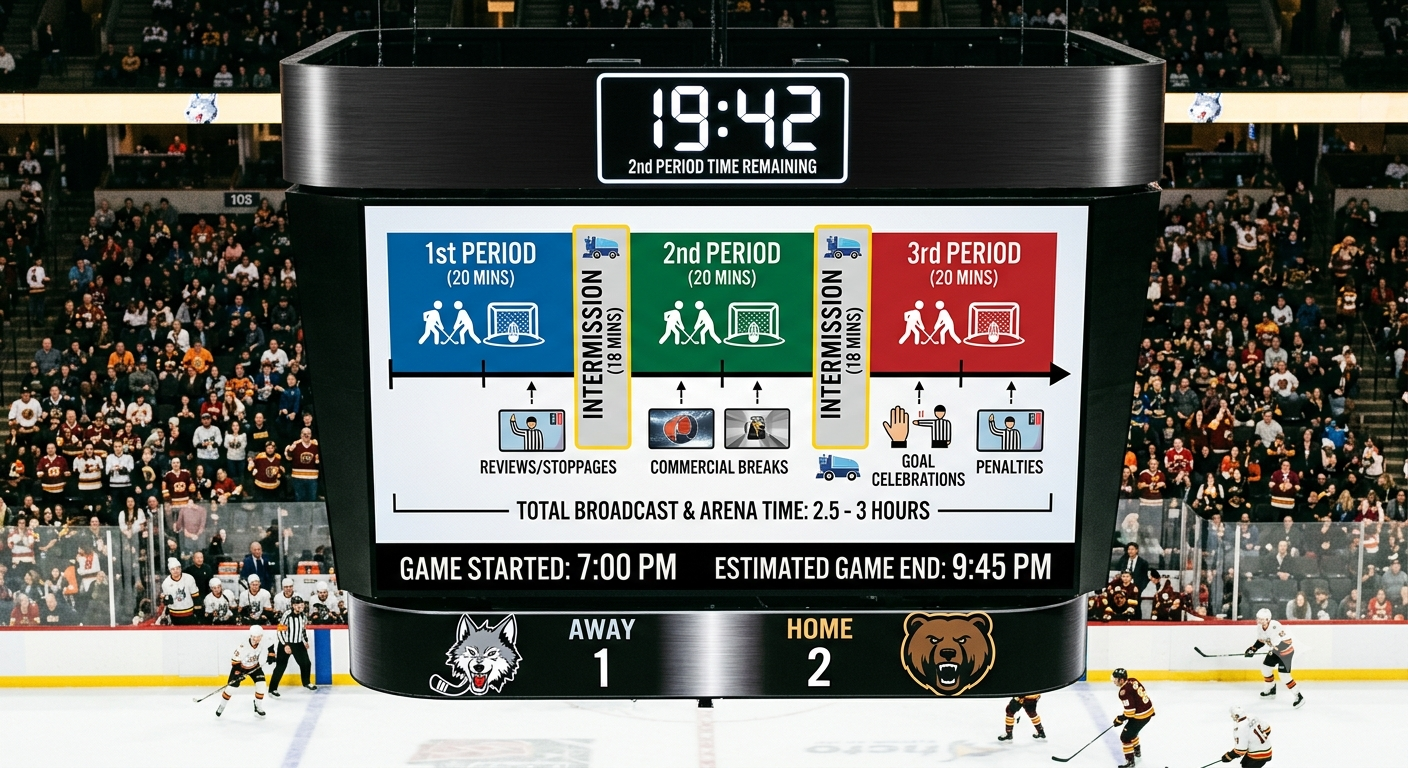
A standard professional hockey game has 60 minutes of playing time divided into three periods.
The structure is:
- First period: 20 minutes
- Second period: 20 minutes
- Third period: 20 minutes
Unlike some sports that use two halves, hockey uses three separate periods with breaks between them.
Each period has a clock winding down from twenty minutes, although time outs stop the flow of the clock, so sixty minutes can also mean something like more than a hour including stoppages.
Why Does a Hockey Game Take More Than 60 Minutes?
The difference between official playing time and actual game duration comes from frequent stoppages.
A hockey game may pause because of:
- A goal being scored
- A penalty being called
- The puck leaving the playing surface
- Icing violations
- Offside calls
- Player injuries
- Equipment problems
- Official reviews
Every stoppage adds time to the overall event.
For this reason, most professional hockey games typically last around two and a half hours, although some games finish faster and others take longer depending on the number of interruptions.
Understanding Hockey Periods
The three-period structure is one of the main aspects of hockey.
First Period
The first period creates the game’s tempo. Both teams try to gain control over the flow of play and score the first goal.
As both teams have rested players at the beginning of the first period, the action in this period is often the most intense.
Second Period
The second period is also significant because it allows coaches to make changes to the lineups based on their observations during the first period.
It is also the time when coaches try to find the best possible combinations of players.
Moreover, this period features the second intermission, which gives players a chance to rest.
Third Period
The third period is the period of final showdown. Teams that have fallen behind in the first two periods give everything to score and change their play style.
Meanwhile, teams that have managed to score the first points try to defend their lead with all of their might. Furthermore, it is in the third period that tie games and close matches see the most exciting action, with both teams leaving nothing on the table in an effort to get a single point.
How Long Are Hockey Intermissions?
Between each period, hockey includes an intermission.
Standardized under the official NHL rulebook, intermissions typically last 18 minutes to allow ice resurfacing, though local competition formats and broadcast schedules can slightly adjust this timing.
Intermissions allow:
- Players to rest
- Coaches to make adjustments
- Ice crews to resurface the rink
- Fans to take breaks
During televised games, intermissions also include analysis, interviews, and highlights.
When adding two intermissions to the three 20-minute periods, the total scheduled time already extends well beyond one hour.
How Long Is an NHL Hockey Game?
For fans asking how long is a hockey game specifically in the NHL, the typical answer is around 2 hours and 30 minutes from start to finish.
A regular NHL game includes:
- 60 minutes of regulation play
- Two intermissions
- Stoppage time
- Commercial breaks during broadcasts
- Possible overtime
Games that require overtime or a shootout can last longer.
For people attending a live NHL game, it is usually wise to plan for approximately three hours at the arena, especially when including arrival time, seating, and leaving afterward.
Factors That Can Make a Hockey Game Longer
Not every game follows the same timeline.
Several situations can extend the duration:
Multiple Penalties
The flow of play can be disrupted by penalty stoppages, as they often give one team a special teams opportunity, usually in the form of a power play.
Video reviews
The officials have the ability to review goals or other plays to ensure that their decision was correct.
Overtime
When a tied game occurs when the regulation time expires the teams will play on until someone scores to win.
Long stoppages
Injuries, equipment problems, ice resurfacing, and other issues can cause delays in the game.
How Long Is Hockey Overtime?
When regulation time expires with a tied game, the hockey match-ups don’t end there: the teams usually proceed to overtime until one decides victorious. During regulation games of hockey the shorter format utilized within the NHL. Is intended to extend for greater goal-scoring opportunities due to less ice available for skaters and less on-ice competition.
If no team scores, these games sometimes even go to a shootout for final adjudication – where individual skaters get scoring chances.
Since the game of overtime isn’t so precise in its scoring method, these games extend by numerous minutes in terms of gameplay. During hockey playoff games, play’s don’t proceed to sudden shootouts, but teams do extend through numerous extra period sessions until one équipe can manage a win – this format often makes games extend much longer compared to regular time contests!
How Long Are College Hockey Games?
College hockey follows a structure similar to professional hockey.
Most college hockey games include:
- Three 20-minute periods
- Intermissions between periods
- Stoppage time
- Possible overtime
A typical college hockey game usually takes around two to two and a half hours from start to finish.
However, tournament games or playoff matches may last longer if overtime periods are required.
How Long Are Youth Hockey Games?
Youth hockey games are usually shorter than professional games because younger players have different physical requirements and skill levels.
The length depends on the age group and league rules.
Many youth hockey games include shorter periods, such as:
- 12-minute periods
- 15-minute periods
- 17-minute periods
Younger age groups often have running clocks, meaning the clock continues during some stoppages. This helps keep games shorter and easier for children.
Parents attending youth hockey games should expect the total event time to vary based on age level, tournament rules, and scheduling.
How Long Is a Hockey Game Compared to Other Sports?
Understanding how long is a hockey game becomes easier when comparing it with other popular sports.
| Sport | Official Playing Time | Typical Total Duration |
| Hockey | 60 minutes | About 2–3 hours |
| Basketball | 48 minutes (NBA) | About 2–2.5 hours |
| Football | 60 minutes | About 3 hours |
| Soccer | 90 minutes | About 2 hours |
| Baseball | No set clock | Often 2.5–3+ hours |
Although hockey has only one hour of official playing time, stoppages and intermissions make the total viewing experience longer, much like tracking real-time market shifts onTuning Crypto.
How Many Hours Did the Longest Hockey Game Last?
Few fans realize that hockey history has some astonishingly long games – particularly, of course, when the stakes are so high. Some playoff matches may go for six hours of game clock. One NHL playoff match required more than six hours before a team managed a victory by one and the other didn’t get out of trouble; I would hardly doubt there are other games similar. There really are many factors that might contribute toward marathon games, although one important factor to keep into perspective is the fact that there’s a definitive winner and losers – unlike soccer games in a playoff environment, for example.
Tips for Planning to Watch a Hockey Game
If you are attending your first live hockey game, planning extra time makes the experience easier.
Consider:
- Arriving early makes it easier to handle parking, navigate the venue, and get to your seats before the action starts.
- Expecting the game to last around three hours
- Checking arena entry policies
- Planning time for food, breaks, and leaving afterward
The actual game may finish sooner, but allowing extra time prevents rushing.
Why Hockey’s Game Time and Real Time Are Different
One reason people ask how long is a hockey game is because the sport’s pace creates a unique viewing experience.
Even with the interruptions it adds to total game time, hockey plays very fast when the puck is moving. Shifts are typically very brief, as players rotate in and out with remarkable frequency and momentum can swing dramatically in a matter of seconds. This combination of pace, strategy and frequent involvement creates a feeling unique from games where extended periods of game play are the norm.
Conclusion
So, how long is a hockey game? The official answer is 60 minutes of playing time divided into three 20-minute periods. However, the real experience usually lasts around two and a half hours because of intermissions, stoppages, reviews, penalties, and possible overtime.
The amount of time for the game depends on the level of play, context of the match, and whether additional time is required to identify a winner. A professional game, including playoff matches, may take significantly longer than amateur ones, which are often shorter.
Having an insight into the game’s total time can help newcomers to understand this sport better. It will also help them to plan what to do in advance, being sure that they have allocated enough time for the match.
Frequently Asked Questions
How long is an NHL hockey game?
An NHL hockey game time lasts for about 2.5 hours on average. However, depending on the number of disputes, stoppages, and overtime, it can sometimes be significantly longer.
Is hockey really only 60 minutes?
Only 60 minutes of actual playing time are counted; the rest of the time is spent on intermissions and stoppages.
How Many Periods Are Played in Professional Hockey?
There are three periods in a hockey game, and each of them is 20 minutes long in professional leagues.
How long is the overtime in hockey?
Overtime duration varies depending on the league, but it is typically divided into sudden death periods during regular time and extended until a winner is decided during the playoffs.
Why is there so much time for stoppages in hockey?
The clock stops when a point is scored, a penalty is called, a player is injured, there is an offside, icing, or disputes that require a review.
How Much Earlier Should You Get to the Game?
To have enough time to find parking, go through security checks, and find your seat, it is better to arrive 30-60 minutes before the start.