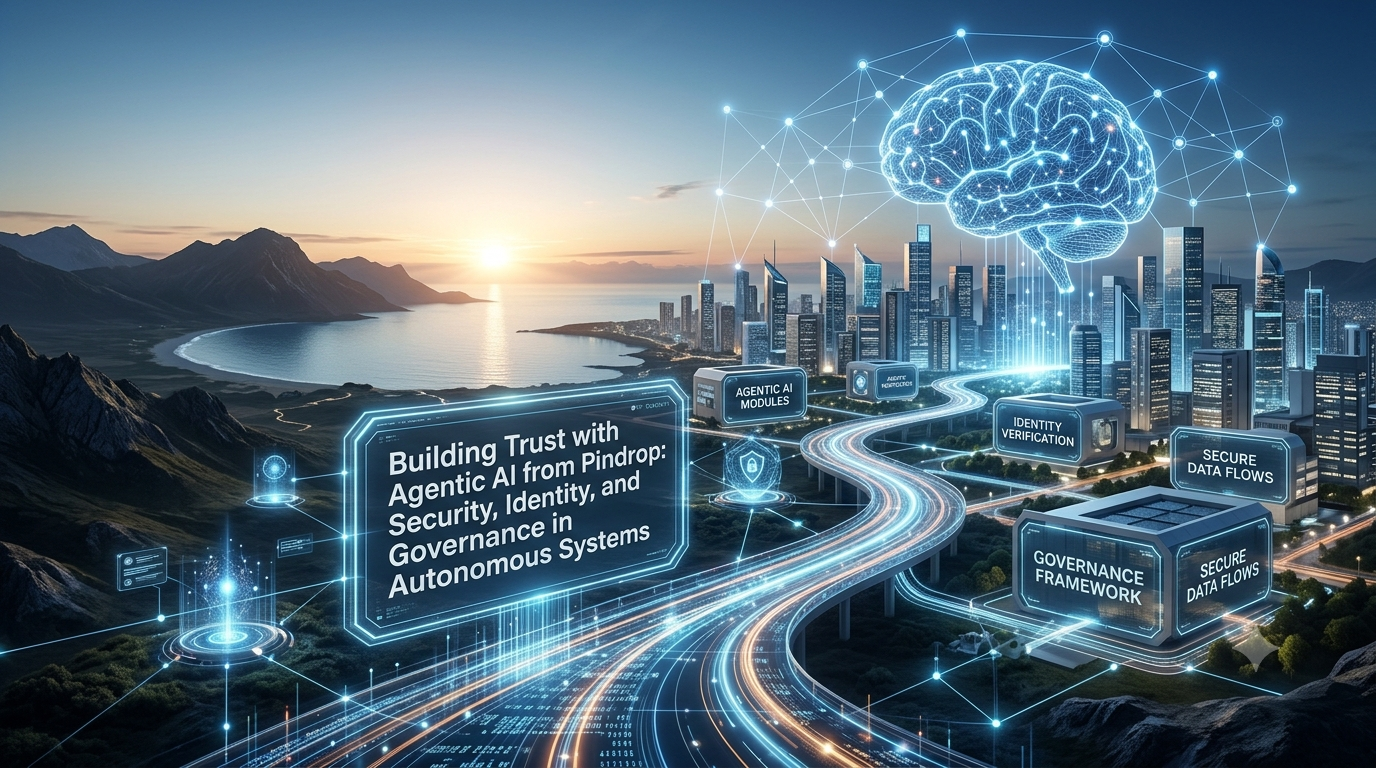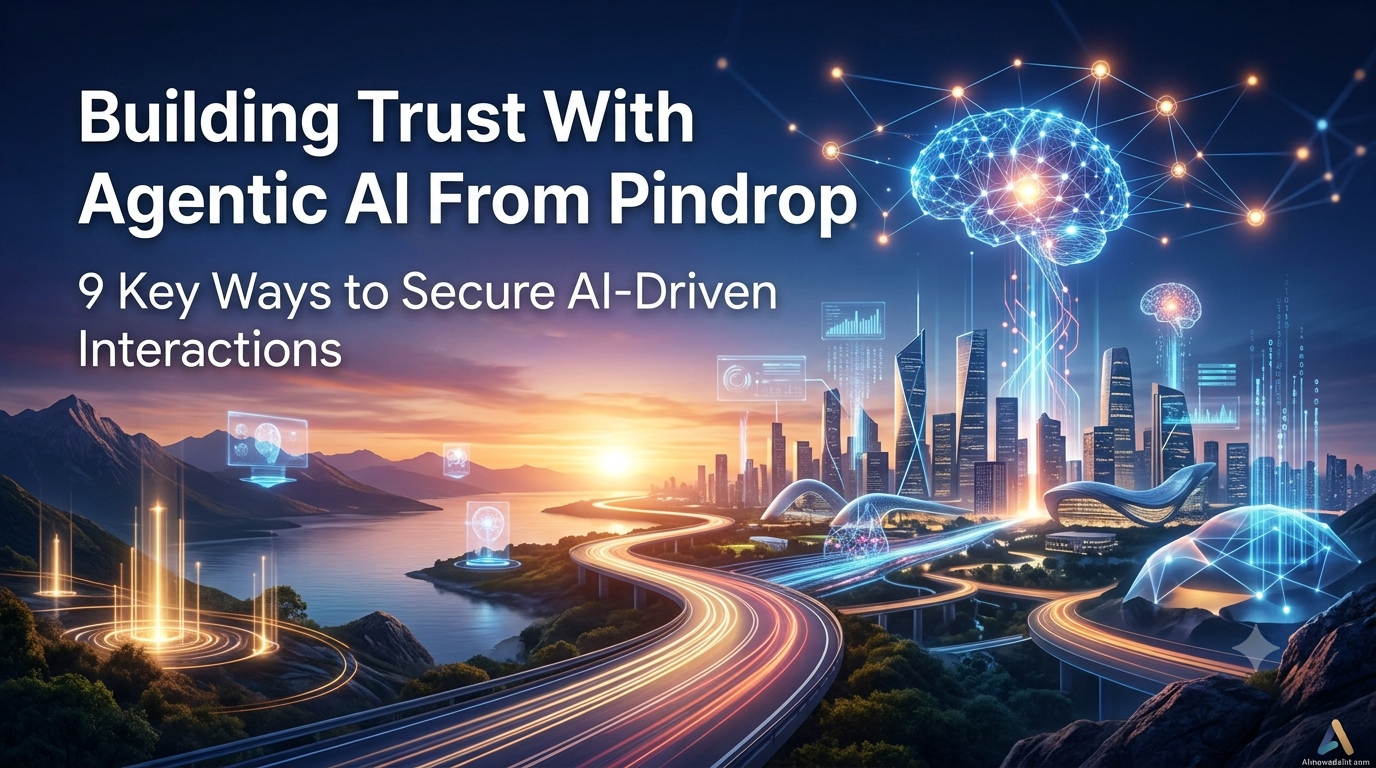
The phrase building trust with agentic AI from Pindrop points to a problem that is becoming harder to solve: how can an organization trust an AI system when both legitimate users and criminals can use increasingly capable AI? Agentic AI can perform tasks, make decisions, interact with customers, and operate with limited human intervention. That creates enormous opportunities, but it also changes the security equation.
In a traditional authentication system we might ask: Is this the correct password, or does this voice sound like the expected voiceprint. In today’s attacks, we need to ask something more: Can this organization trust this identity, this transaction, and this action at this exact time? Pindrop’s tools address this in four categories; voice verification, fraud identification, deepfake detection, device and meta data examination, and continuous risk rating. Pindrop’s main products are: Pindrop Passport, Pindrop Protect, and Pindrop Pulse.
Why Agentic AI Changes the Trust Equation
Unlike just a chatbot, an agentic AI has its own agenda or goal. It’s equipped to carry out multiple steps toward this goal, often requiring less guidance. For example, an agent in a business application might become the system that schedules meetings, pulls up account information, guides customers through processes, starts work processes or even assists in searching through suspicious data.
This degree of automation is convenient, yet with that level of automated confidence comes risk of making identification mistakes.
An illustration comes from a typical customer-service system where the phone call comes in from a person who says he is an account holder. The caller offers such good personal data and the voice even sounds very natural, and a traditional workflow is content just with validating the voice. This “all is good” process, however, falls into dangerous territory now that synthetic voices can sound quite convincing to that system.
Pindrop materials and research make the risk of using voice as a reliable indicator of who’s really calling very clear, highlighting its ability to distinguish real voices from recordings of recorded voices, and use voice signals along with a host of other characteristics instead of viewing solely voice as proof of who is on the line (for instance, the Pindrop Passport integrates data on a call across device, data, metadata, voice, behavior and risk analysis).
Bigger picture: trust isn’t a single event, it should be dynamic and evaluated on an ongoing basis.
The Problem With Treating Voice as Proof of Identity
For decades, voice could be a strong identification signal, simply because replicating someone’s voice was difficult. But with generative AI technologies, that was never more the case. Pindrop cites five types of voice attack, including recorded voice, speech, voice automated voice assistants, voice conversion, and the replay technique.
Although they vary technically, all aim to fool people that the artificial interaction is with a human.
A sufficiently advanced voice fraud attack can thus pass any system that rely to0 much on what the person on the other line is actually saying and on how close is their voice to the known user, for instance, he adds. This is why Pindrop’s analysis technology looks at more than just matching someone’s voice – his system uses Passport, with Phoneprinting technology, Toneprinting technology, metadata analysis, behavioral analysis, risk assessment and even a liveness check that confirms the caller actually exists and they are real on the other end of the line. This layered strategy is critical, because different indicators can fail on their own. A well known person’s voice on a never seen before device: suspect.
An official voice, from a regular number, but making robot like commands: suspect.
A voice known for calling and, on the surface, it is him/her calling that number but, underneath, there is another person: still suspicious.
Trust becomes stronger when several independent signals tell the same story, which is a core principle of zero trust security.
How Pindrop’s Technology Fits Into Agentic AI Security
Pindrop
Pindrop’s technologies can be understood as different layers of a broader security architecture.
Pindrop Passport: Establishing Caller Identity
Pindrop Passport is built with real-time, multifactor caller authentication. Instead of making every customer jump through hoops on some lengthy security questionnaire the system can evaluate these back-end signals in parallel while the conversation is underway. The system takes voiceprint, phone traits, carrier traits, metadata, behavior traits and risk factors into consideration.
For agentic systems this is particularly pertinent.
AI agents must have access to data they can trust before taking any action.If an automated system receives commands from a compromised identity, then automation has the potential to magnify the error. Authentication is therefore the bedrock of automated decision-making.
Pindrop Protect: Looking for Fraud Patterns
Authentication answers one question: Who might this caller be?
Fraud detection asks a different question: Does this interaction look suspicious?
Pindrop Protect provides a risk assessment for calls and analyzes signals across the IVR and agent stages. The platform considers voice, device, metadata, behavior, and information from its fraud intelligence network.
That distinction is important.
A legitimate customer’s identity may be correctly recognized while the transaction itself remains suspicious. For example, an attacker could compromise an account before contacting a call center. A voice match alone would not necessarily reveal the compromise.
A stronger system evaluates both identity and behavior.
Pindrop Pulse: Detecting Synthetic Voices
Pindrop Pulse addresses one of the most direct threats to voice-based trust: synthetic speech.
Pindrop said that Pulse analyzes inbound calls and can determine if it’s using deepfake audio. Detection can be real-time enough for risk assessment during an interaction, too. Pindrop says it can now detect deepfake audio in two seconds and its accuracy can reach 99% with its multi-factor authentication platform. (Keep in mind these are company reported metrics, and those considering them should weigh their environment, speech quality, languages spoken, attack types and environmental conditions.)
The broader principle is more important than any single benchmark: AI-generated speech needs to be evaluated as potentially manipulated media rather than automatically accepted as human evidence.
Why Deepfake Detection Alone Is Not Enough
Perhaps the most obvious answer comes to mind – we need to detect deepfake voices. As it turns out, however, that’s only one piece of the puzzle regarding enterprise security. Imagine if an attacker compromises a real user, and uses a genuine recording to simulate calls from them, while being authenticated directly as that user.
There’s nothing to detect!
What’s more, imagine we could actually detect a synthetic voice but didn’t have any policy or process in place to deal with alerts the solution generates.
This is why trust requires several connected layers:
Identity → Liveness → Context → Behavior → Risk → Action
The first layer defines who seemingly is interacting. Liveness verifies that the voice is produced by a human rather than generated media. Context determines the nature of interaction.
Behavioral analysis detects anomalous behavior.
Risk assessment integrates the signals. Then, an action policy decides if the system should proceed, ask for more verification, or move up a level.
That architecture is more resilient than relying on one technology.
Agentic AI Needs Both Machine Identity and Human Verification
One of the significant developments within this domain is the understanding that the AI agents must, themselves, have identities that users can trust. One company, Pindrop, has raised that the enterprise AI security must check the identity of the AI agent as well as ensure that the right individual has given approval on highly risky actions. It’s an interesting differentiation point.
Yes, an agent may be programmed to execute certain actions.

But it’s not intelligent in enough depth and breadth to know how to tell whether an given command presented to the agent can be believed -or is merely someone who is simulating the boss’s voice, sending the agent instructions to go ahead and approve the payment.
The security architecture therefore has to answer two questions:
- Is this the authorized AI agent?
- Is the human authority behind the requested action genuine?
For low-risk activities, automated handling may be appropriate. For high-impact actions, organizations may require stronger authentication or human approval.
That principle is likely to become increasingly important as AI agents gain access to financial, customer, operational, and administrative systems.
Building Trust Requires Risk-Based Decisions
Not every interaction deserves the same level of scrutiny.
Calling an automated service to ask about business hours doesn’t pose the same risk as asking to initiate a large account transfer. Putting the same security rigor into each creates needless friction. A better approach is risk-based authentication.
If an activity falls low on the risk ladder, we might only needpassive authentication and passive analysis.
If it comes up moderate on the risk spectrum, we prompt for more verification. On high-risk requests, we mandate human verification or strong authentication. The thresholds for these should be set internally-not copied from the environment of the company next door. Fraud profiles vary, as do regulatory requirements, consumer preferences, and financial impact.
We’re not trying to add the most friction; we aretrying toadd Friction when and where it makes sense.
Why Human Oversight Still Matters
Agentic AI is intended to minimize human interference, but taking people out of all security decision-making will introduce new vulnerabilities. A system should be designed to have AI execute simple analysis, while ensuring humans are in control of exceptions. For instance, when a fully automated system detects a confluence of synthetic voice tells and unusual call patterns/account activity, it would not allow a fully autonomous agent to complete the requested action. Instead, the agent could transfer the interaction:
This creates a useful division of labor:
AI detects patterns and processes signals quickly. Humans handle ambiguous, high-impact decisions.
That balance becomes especially important when a false positive could inconvenience a legitimate customer or when a false negative could create financial or reputational damage.
Common Mistakes Organizations Should Avoid
Relying on Voice Alone
The fact that a caller may be identified by matching voices shouldn’t imply the calling stranger is safe and legitimate. It might come in the form of a compromised account, clever social engineers, spoofed caller ID, a compromised mobile, or even synthetic speech with identical human traits.
Treating Deepfake Detection as a Complete Security Strategy
Fighting Synthetic Media While some forms of fraud can be defeated with this technology, deepfake detection will not solve them all. Businesses still require account security and controls, transaction monitoring, access control, device intelligence and a holistic cybersecurity strategy.
Giving AI Agents Excessive Authority
The agent needs to only be granted permissions to do its task. It is prudent to have tighter controls for tasks that carry higher significance.
Ignoring the Human Approval Layer
If a system can accept a voice instruction from a supposedly senior employee and immediately execute a high-value action, the organization has created a dangerous trust gap.
Failing to Reassess the System
Fraud techniques evolve. A security configuration that performs well today may not perform the same way against tomorrow’s attack techniques.
Continuous monitoring, testing, and review are therefore essential for maintaining a strong cybersecurity strategy.
What Organizations Can Learn From Pindrop’s Layered Model
But Pindrop’s greatest insight wasn’t a signal that can defeat all fraudulent inputs. It was a realization that trust is built by analyzing not one piece of input, but many. Passport, for instance, focuses on authentication; Protect on detection and risk assessment, while Pulse tackles the rise of synthetic and deepfake audio, providing a holistic picture that surpasses the insight from a single signal.
This multi-layered philosophy reflects and fits with the overarching principles of contemporary cybersecurity: a no-single-point-of-failure belief in assessing the reliability of interaction through the confluence of various input-nothing should be overly relied upon and as interactions unfold, continuously question whether underlying premises remain constant and dependable.
This paradigm shift, moving beyond “was authentication successful?” to “Does the transaction as a whole retain its trustworthiness?” – is an indispensable consequence of the AI-driven fraud landscape.
The Privacy Question Cannot Be Ignored
Security systems that analyze voice and behavioral information also raise privacy questions, particularly around biometric data privacy.
An organization must clearly know what information it will collect, what it will keep, who might use it, and for what purpose. Since voice authentication can usebiometric data,governance has special salience in places wherebiometric datais explicitly protected by statute. Security practitioners thus need to engage privacy, legal, compliance and data-governance expertise prior to scaling the voice intelligence program. Although a technically perfect solution will have all the elements needed, organizations will run into problems if its data habits, whatever they may be, do not adhere to applicable requirements.
What the Future of Trusted Agentic AI May Look Like
The direction of travel is toward continuous verification.
Rather than verifying a person only once and then trusting everything thereafter, future systems will more likely consider all aspects of identity, device, behavior, location, communication patterns, and the context of a transaction in real time. Pindrop is even adapting its model beyond just the telephone. The company is already testing its deepfake technology on meetings where it analyze’s the audio and video of conversations live.
This reflects a larger trend: identity is becoming contextual.
A person may be genuine, their device may be genuine, and their voice may be genuine, yet the action they are attempting could still be fraudulent.
Agentic AI makes this distinction especially important because automated systems can move from observation to action much faster than traditional software.
The better the automation becomes, the more important trustworthy inputs become.
Final Perspective: Building Trust With Agentic AI From Pindrop
Building trust with agentic AI from Pindrop is ultimately less about trusting AI blindly and more about giving AI reliable evidence on which to act. Voice authentication combined with deepfake detection, fraud intelligence, device analysis, behavior detection and risk scoring will help forge the backbone of robust automated decision-making.
Today’sPindrop security model demonstrates why any one-time verification cannot be used in isolation for making such an assessment; Passport may give assurance over a call’s identity, Protect can determine fraud over the rest of the interaction and Pulse could potentially discern synth voice. None of this should be a brick wall; defences needs layering, AI governance must be strict, human approvals on critical decisions are vital and privacy must always be respected and technology must continuously adapt.

At the end of the day, you don’t want to build a burden of friction; you want to enable confidence and remove easy automation for malicious entities.
This is how agentic AI gets its opportunity to provide real value at enterprise scale without additional compromise for additional automation.
Frequently Asked Questions
1.What does building trust with agentic AI from Pindrop mean?
The context here is building a secure environment for AI interactions with the help of trustworthy signals from identity, liveness, behavior, device, metadata and fraud risk. Pindrop’s technology allows companies to analyze these kinds of signals on top of voice and other engagements.
2.How does Pindrop detect AI-generated voices?
Pindrop Pulse performs an analysis of your audio data and identifies characteristics commonly found in synthetic speech. The Pulse also delivers a “liveness” signal that aims to verify when audio has been produced by a human instead of an AI. According to Pindrop, Pulse is able to process calls in about two seconds.
3.Is voice authentication enough to prevent AI fraud?
No, voice authentication is a single data point. An effective security architecture might leverage a layered approach, incorporating voice along with device analytics, transaction risk, metadata, liveness detection, and behavioral analytics.
4.What is the role of Pindrop Passport?
Pindrop Passport is the multifactor caller-authentication solution combining voice data and additional signals including: phone, device, metadata, behavior and risk data – so organizations do not have to ask security questions the customer might forget. Pindrop can help verify incoming callers.
5.What does Pindrop Protect do?
It is solution for fraud detection and risk assessment applied to contact center interactions, analyzing various signals and giving a risk assessment that is context transferable through call phases.
6.Can agentic AI completely eliminate human involvement?
We assume it may also be used to make decisions to automate or require additional human review – standard risk, low stakes decisions may automate while high stakes decisions need humans with experience dealing with those situations, financial risk, and the ability to be very nuanced. Or those dealing with identity or where the risks around security need humans.
7.Why is deepfake detection becoming important for businesses?
Generative AI simplifies the creation of realistic impersonations of voices and other types of deception. As contact centers, executive communications, financial services, and others traditionally trust voice and video as proof of identity, there are clear security threats. The company states that deepfake detection is one aspect of its enterprise interaction defense model.
Conclusion
Building trust with agentic AI from Pindrop is ultimately about more than giving AI systems the ability to act independently.Essentially, enabling them to become understandable, secure and auditable as they interact with customers and run business process…. As AI agents assume more functions, businesses need assurance that those interacting with critical processes can separate genuine user from potentially criminal element while reacting dynamically.
The rationale behind Pindrop solution explains why Identity, Voice intelligence, fraud detection and ongoing risk assessment become pieces of this solution, as agentic AI creates genuine efficiency where controls can be placed on its decision making and it can verified against credible signals. This is the basic premise and that autonomous AI should not rely on faith but trust which can be fostered by creating systems where controls can be developed through transparency, security, continuous validation and human or automatic validation. Implementing such controls would be essential when organizations investigate the deployment of agentic AI systems: