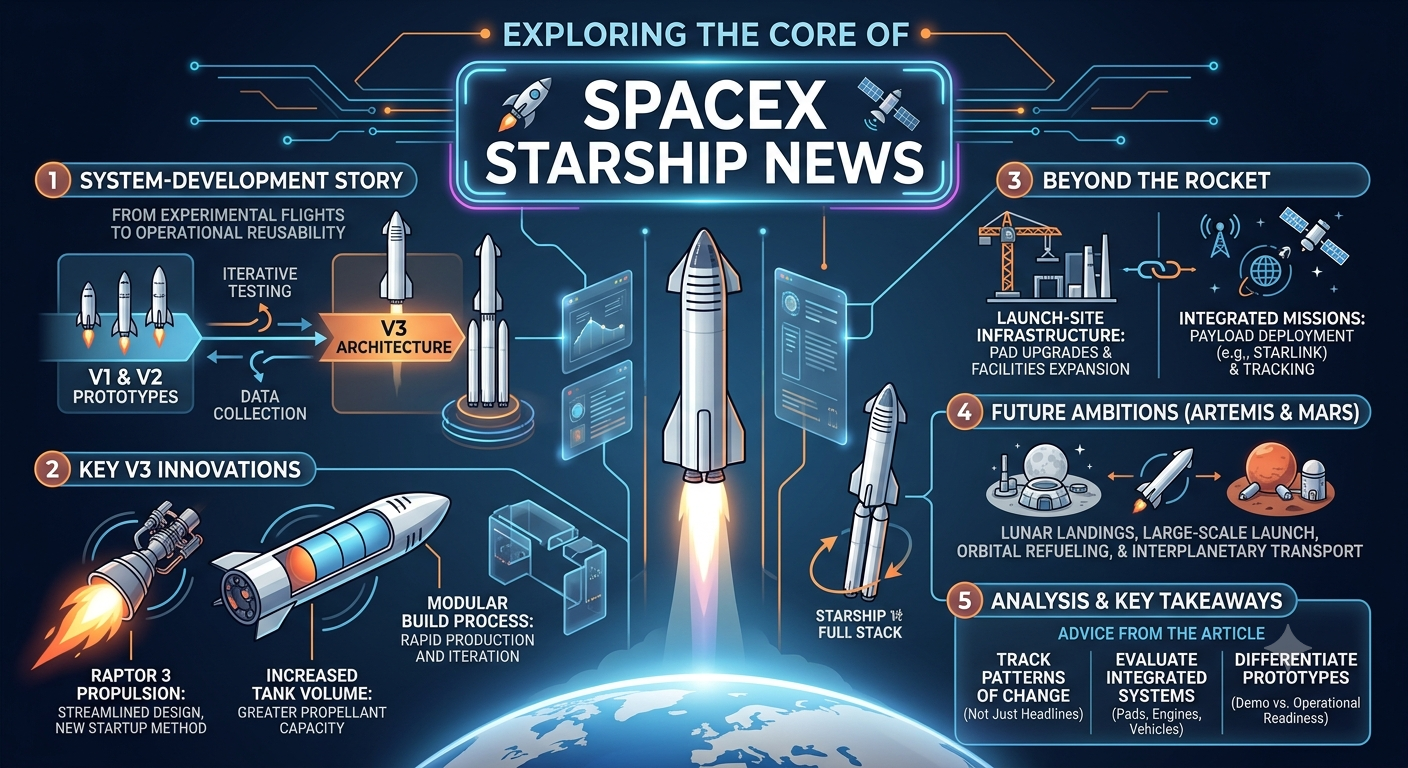
SpaceX Starship news has become one of the most closely watched topics in aerospace because the program is moving from experimental development into a more mature test-and-iteration phase. The system is not just a rocket; it is SpaceX’s long-term architecture for large-scale launch, orbital refueling, lunar missions, and eventually Mars transport.
The most important thing to understand is that Starship progress does not happen in a straight line. Each flight, ground test, redesign, and launch-site change reveals a different part of the engineering puzzle, which is why every new update attracts so much attention.
Why This Topic Matters
SpaceX Starship news matters because Starship sits at the center of multiple future space ambitions at once. It is tied to heavy-lift launch capability, Starlink deployment, deep-space mission planning, and NASA’s Artemis lunar architecture.
That makes each major update relevant far beyond SpaceX itself. A design change in one section of the vehicle can affect launch cadence, payload capability, recovery strategy, and mission readiness for years to come.
For readers, the topic is also useful because Starship is not simply a future concept anymore. It is a live program with test flights, pad upgrades, vehicle redesigns, and new production logic that can be tracked like an evolving industrial system, much like how developers and analysts track macro shifts across the broader tech and crypto markets.
Expert Analysis
The clearest way to read SpaceX Starship news is to view it as a system-development story rather than a simple launch story. SpaceX is using flight tests to validate not only whether the rocket can fly, but whether the entire stack can be produced, operated, reused, and improved fast enough to support regular missions.
The move toward Starship V3 is especially important because it signals a more substantial redesign rather than a small update. SpaceX has described V3 as incorporating a clean-sheet redesign of propulsion systems, a new Raptor startup method, and increased propellant tank volume, all of which point to a major step in performance architecture.
That matters because the company is not merely trying to make a bigger rocket. It is trying to make a bigger rocket that can also become more operationally reliable, which is the harder problem. A giant launch vehicle is impressive; a giant launch vehicle that can be produced repeatedly and refined through rapid iteration is transformative
Breaking Down The Main Topic
Recent SpaceX Starship news has centered on the shift from earlier prototypes to the newer V3 generation. SpaceX’s twelfth flight test, flown from Starbase on May 22, 2026, was the first flight of the Starship and Super Heavy V3 vehicles, the Raptor 3 engines, and the first flight from
That flight also included the first Starship mission to deploy modified Starlink satellites to image Starship in space, which is a useful reminder that the program is already serving both engineering and operational demonstration goals. It is no longer just about whether the rocket can launch; it is also about whether future support functions can work in real mission conditions.
The broader development picture suggests a deliberate shift from proving isolated capabilities to testing integrated systems. Pad infrastructure, vehicle versioning, engine updates, and launch-side operations are being advanced together, which is typical of a program moving toward higher-frequency testing and eventual operational use
Timeline of Recent Progress
A useful way to understand SpaceX Starship news is to follow the milestones rather than treat each headline as disconnected. SpaceX’s public updates show a steady move into Starship V3, while the twelfth flight test marked an important milestone by using new vehicle and engine versions in a real launch
The company’s updates page also points to changes beyond the rocket itself, including new propulsion design choices that support a different startup method and larger propellant capacity. That suggests SpaceX is working on the underlying architecture, not just polishing the surface of the current design.
Meanwhile, reporting around launch-site and infrastructure work indicates continued preparation for future flights and facility expansion, which is often where the real pace of a program can be seen. Test hardware matters, but the ability to support repeat flights depends heavily on the ground system.
Practical Applications
The practical value of SpaceX Starship news extends beyond enthusiasts following launch dates. For aerospace professionals, each update provides clues about reusable system design, thermal protection, booster recovery logic, engine restart performance, and launch-site engineering.
For satellite operators, Starship’s eventual operational maturity could matter because its large payload capacity may change how constellations are deployed and how missions are planned. Although still undergoing testing, the program has already begun influencing expectations regarding payload volume, mission cadence, and the economics of future launches.
For policy and program watchers, the news also helps frame what kinds of aerospace capabilities are becoming plausible within the next few years. Starship is one of the few vehicles in active development that could potentially affect both commercial launch markets and human exploration planning at the same time.
Challenges In Focus
A realistic reading of SpaceX Starship news has to include the difficulty of what SpaceX is trying to build. Launching a rocket is only one part of the problem; recovering it, reusing it, and flying it again quickly is a separate challenge.
The technical hurdles include engine reliability, stage separation performance, thermal protection, vehicle control during reentry, and pad infrastructure durability. These issues are especially complex for a system as large and ambitious as Starship because minor weaknesses can have major consequences at scale.
Another challenge is expectation management. Because SpaceX moves fast and publishes a lot of milestones, the public often interprets each update as a near-final breakthrough. In reality, each success still sits inside a long development cycle where progress and failure can happen in close succession.
Real-World Context
A useful case study inside SpaceX Starship news is the official data gathered during the twelfth flight test. It was not just another launch; it was the first mission for the V3 vehicles, the first flight with Raptor 3 engines, and the first flight from Pad 2, making it a layered test of upgraded hardware and launch infrastructure at the same time.
That kind of milestone is important because it shows how modern space programs validate change. Instead of changing one element at a time in complete isolation, teams often test multiple linked improvements together once earlier risk has been reduced enough to justify the step.
The case also shows why a single headline can hide a lot of engineering meaning. A casual reader may see “another Starship launch,” but a technical reader sees the introduction of new propulsion, launch-pad usage, and mission payload behavior all in one flight.
Troubleshooting The Noise
One of the biggest problems readers face with SpaceX Starship news is separating verified updates from speculation. The online conversation around Starship is huge, and that often means launch rumors, concept videos, and commentary get mixed in with factual progress reports.youtube+1
A second issue is that launch testing often gets simplified into a binary success-or-failure frame. In reality, test programs are designed to collect data, and a flight can be valuable even if every objective is not completed perfectly. That is especially true for a system still moving through version changes.
A third issue is understanding the difference between prototype testing and operational readiness. A vehicle can be technically impressive and still not be ready for routine missions, so readers should always ask whether an update reflects demonstration, qualification, or active service capability.
Professional Advice
If you follow SpaceX Starship news professionally, the best approach is to track categories of change rather than individual hype cycles. Separate vehicle hardware changes, engine changes, pad and launch infrastructure changes, mission objectives, and long-term program goals.
It also helps to read updates in context. A new flight test matters differently if it introduces a new vehicle version, a new launch site, or a new engine family. Those distinctions reveal where the program is in the development curve.
Finally, it is smart to watch for patterns rather than isolated claims. Repeated improvements in launch preparation, engine maturation, and hardware redesign usually tell you more about the program’s future than a single dramatic headline does.
Frequently Asked Questions
What is the newest major development in SpaceX Starship news?
The twelfth flight test was a major recent milestone, and it featured the first flight of the Starship and Super Heavy V3 vehicles along with Raptor 3 engines.
Why is Starship V3 important?
SpaceX says V3 includes a clean-sheet redesign of propulsion systems, a new Raptor startup method, and more propellant tank volume, which suggests a significant step forward in the program.
Is Starship only a test rocket?
No. SpaceX positions Starship as a long-duration interplanetary transport system and a major launch platform, so its role extends well beyond testing alone.
Why do some updates focus on launch pads and facilities?
Because launch infrastructure is part of the system. Pad upgrades, proof testing, and construction work can be just as important as the rocket itself for reaching a sustainable launch rate.youtube+1
Final Thoughts
The most accurate way to read SpaceX Starship news is as a story of integrated development: hardware, engines, launch sites, and mission design are all evolving together. That makes the program unusually important, because it is not simply aiming for one successful flight but for a scalable launch system.
The near-term story is about V3 validation, pad readiness, and continued testing pace. The larger story is about whether SpaceX can turn a highly ambitious prototype into a repeatable space transportation system.