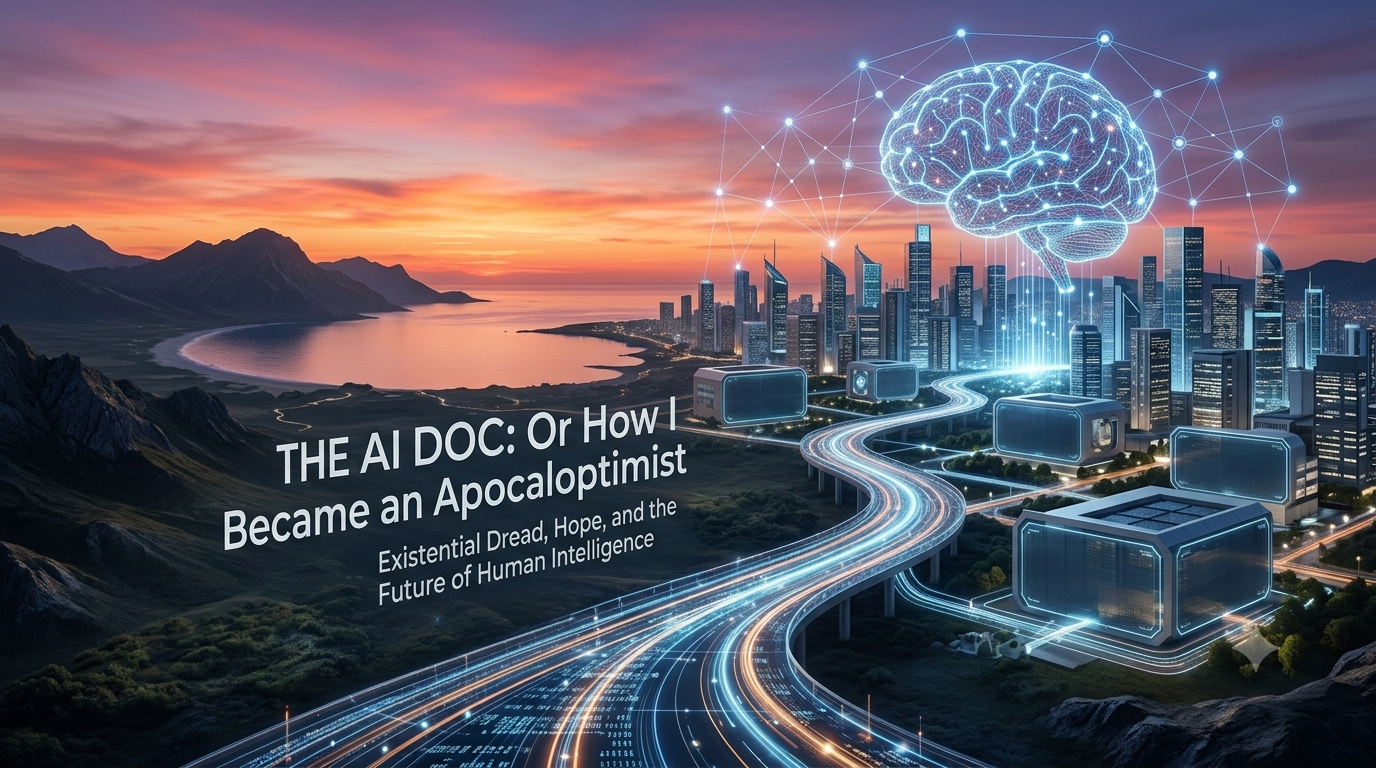
When Academy Award-winning filmmaker Daniel Roher (Navalny) discovered he was going to become a father, his excitement was immediately shadowed by a profound, modern angst. Artificial intelligence was advancing at a breakneck speed, reshaping art, labor, governance, and existential philosophy in real time. Seeking to understand the world his unborn child would inherit, Roher teamed up with co-director Charlie Tyrell and the Oscar-winning producing duo Daniel Kwan and Jonathan Wang (Everything Everywhere All at Once) to create The AI Doc: Or How I Became an Apocaloptimist. Making its world premiere at the 2026 Sundance Film Festival before its global theatrical release by Focus Features, the documentary tackles humanity’s most urgent, polarizing technology.
At its core, The AI Doc: Or How I Became an Apocaloptimist introduces viewers to a specific psychological posture: “apocaloptimism” the simultaneous belief that artificial intelligence poses genuine existential risks to Civilization while offering unprecedented potential to cure diseases, reverse environmental damage, and unlock extraordinary human flourishing. Rather than offering a detached academic survey, The AI Doc: Or How I Became an Apocaloptimist anchors its narrative in an intimate, fatherly quest for clarity.
This comprehensive analysis explores the cinematic architecture, interview subjects, thematic debates, production values, and cultural resonance of The AI Doc: Or How I Became an Apocaloptimist.
1. Film Profile and Production Overview
To contextualize The AI Doc: Or How I Became an Apocaloptimist, it is essential to look at the creative team, release trajectory, and structural backing that brought this project to life.
┌──────────────────────────────────────────────────────────────────────────┐
│ FILM METADATA & PRODUCTION PROFILE │
├───────────────────┬──────────────────────────────────────────────────────┤
│ TITLE │ The AI Doc: Or How I Became an Apocaloptimist │
│ DIRECTORS │ Daniel Roher, Charlie Tyrell │
│ PRODUCERS │ Shane Boris, Diane Becker, Daniel Kwan, Jonathan Wang│
│ DISTRIBUTOR │ Focus Features (Universal Pictures International) │
│ PREMIERE │ Sundance Film Festival (January 27, 2026) │
│ THEATRICAL RELEASE│ March 27, 2026 │
│ RUNTIME │ 104 Minutes │
│ CINEMATOGRAPHY │ Jenni Morello, Lowell A. Meyer │
│ EDITING │ Davis Coombe, Daysha Broadway │
└───────────────────┴──────────────────────────────────────────────────────┘
The Personal Frame: A Father’s Quest
The foundational hook of The AI Doc: Or How I Became an Apocaloptimist rests on personal vulnerability. Roher constructs a DIY recording studio inside his home, creating a space where the world’s most powerful tech titans, safety researchers, and fierce critics come to sit across from a father-to-be trying to parse the future. This intimate setting strips away corporate PR gloss, forcing industry leaders to speak candidly about human survival, legacy, and ethics.
2. Defining “Apocaloptimism”: The Psychological Dual-State
A central achievement of The AI Doc: Or How I Became an Apocaloptimist is its coining and unpacking of the term “apocaloptimist” within the mainstream AI lexicon.
┌──────────────────────────────────────────────────────────────────────────┐
│ THE APOCALOPTIMIST SPECTRUM │
├──────────────────────────────────────────────────────────────────────────┤
│ │
│ [DOOMERISM / EXISTENTIAL DREAD] ◄───────► [ACCELERATIONISM / BOOSTER] │
│ │ │ │
│ └──────────────────┬─────────────────┘ │
│ ▼ │
│ [THE APOCALOPTIMIST] │
│ Acknowledges existential hazards & risks, yet actively strives │
│ and builds toward transformative, humane outcomes. │
│ │
└──────────────────────────────────────────────────────────────────────────┘
Navigating Cognitive Dissonance
In modern technology discourse, discussions often bifurcate into extreme doomerism (the belief that artificial general intelligence will inevitably cause human extinction) or unbridled tech-accelerationism (the belief that AI development must proceed at maximum speed without regulation). The AI Doc: Or How I Became an Apocaloptimist intentionally occupies the volatile middle ground. The film argues that panic can leave people powerless, but blindly embracing optimism can be just as dangerous. By adopting “apocaloptimism,” the narrative validates legitimate fears while cultivating the agency required to demand responsible innovation.
3. The Interviewees: A Panoramic Map of the AI Ecosystem
One of the most impressive feats of The AI Doc: Or How I Became an Apocaloptimist is its sprawling, high-caliber list of interview subjects. The directors managed to gather figures across every faction of the artificial intelligence ecosystem.
Industry Pioneers and Frontier Model Builders
- Sam Altman (OpenAI): Provides insight into the commercial drive and transformative vision of large language models.
- Dario Amodei & Daniela Amodei (Anthropic): Discuss the necessity of constitutional AI, safety alignment, and responsible scaling laws.
- Demis Hassabis & Shane Legg (Google DeepMind): Reflect on scientific breakthroughs like protein folding alongside the systemic guardrails required for superintelligence.
- Ilya Sutskever: Shares reflections on safety alignment and the philosophical gravity of creating systems smarter than humanity.
Safety Researchers and Existential Risk Theorists
- Eliezer Yudkowsky: Represents the stark, uncompromising warning against unaligned AGI.
- Tristan Harris & Aza Raskin (Center for Humane Technology): Detail how engagement-driven algorithms undermine social cohesion, democracy, and cognitive agency.
- Dan Hendrycks, Connor Leahy, and Jan Leike: Explore the technical mechanics of AI containment, alignment tax, and governance models.
Ethicists, Historians, and Critics
- Timnit Gebru & Emily M. Bender: Critique the immediate environmental, labor, and social harms of large-scale AI deployment, countering hype cycles.
- Yuval Noah Harari: Frame the rise of autonomous decision-making as a turning point in human civilization, language, and institutional trust.
- Karen Hao & Sneha Revanur: Examine digital labor exploitation, supply chain impacts, and youth-led policy activism.
4. Analytical Matrix: Mapping Perspectives in the Film
The following matrix illustrates how The AI Doc: Or How I Became an Apocaloptimist categorizes the core viewpoints presented across its interviews.
| Perspective Category | Key Figures Featured | Primary Concerns / Arguments | Proposed Solutions / Actions |
| Frontier Builders | Sam Altman, Dario Amodei, Demis Hassabis | Stagnation risks; failure to solve medicine, energy, and economics | Scaled compute, self-regulating alignment, constitutional guardrails |
| Existential Theorists | Eliezer Yudkowsky, Connor Leahy | Loss of control; rapid, unaligned superintelligence leading to catastrophe | Global compute caps, hardware monitoring, international treaties |
| Human Rights & Ethics | Timnit Gebru, Emily M. Bender, Karen Hao | Data extraction, algorithmic bias, labor displacement, corporate monopoly | Whistleblower protection, labor rights, algorithmic auditing, open access |
| Civilizational Historians | Yuval Noah Harari, Tristan Harris | Collapse of shared reality, erosion of democratic discourse via automated noise | Public awareness, humane interface design, strict liability for platforms |
5. Filmmaking Methodology and Directorial Vision
The creative choices behind The AI Doc: Or How I Became an Apocaloptimist elevate it beyond standard talking-head documentaries. Directors Daniel Roher and Charlie Tyrell blend handmade aesthetics with high-tech visuals to emphasize human intimacy.
1.Step 1: Building the Home Studio Base:Domestic Sandbox.
Daniel Roher constructs a minimalist, warm recording space inside his home, creating an inviting environment for tech leaders to engage in unscripted, reflective dialogue.
2.Step 2: On-the-Ground Global Inquiry:Global Fieldwork.
The production team travels across Silicon Valley, European AI research labs, and academic centers, capturing raw footage of datacenter expansion and lab testing.
3.Step 3: Blending Physical Art with Digital Analysis:Tactile Juxtaposition.
Co-director Charlie Tyrell incorporates stop-motion animation, archival footage, and tactile props to visually represent abstract concepts like neural networks and alignment taxes.
4. Step 4: Balancing Dread With Active Agency Through Editorial Convergence
Editors Davis Coombe and Daysha Broadway weave together personal family video logs with heavy existential debates, ensuring the narrative remains emotionally grounded.
The “Handmade” Visual Grammar
In an era dominated by sleek, AI-generated synthetic media, The AI Doc: Or How I Became an Apocaloptimist intentionally employs physical, tactile craftsmanship. Paper-cut animations, physical models, and optical lenses are used to illustrate complex mathematical ideas like high-dimensional vector spaces and loss functions. This choice reminds the viewer that despite the vastness of digital infrastructure, human agency remains the ultimate author of these tools.
6. Core Thematic Pillar 1: Existential Risk vs. Technological Breakthroughs
A significant portion of The AI Doc: Or How I Became an Apocaloptimist grapples with the tension between catastrophe and paradise.
The Threat of Unaligned AGI
The documentary lays out the technical challenge of the “alignment problem”—how to ensure an autonomous intelligence acts in accordance with human values when its reasoning exceeds human understanding. Through sharp conversations with Eliezer Yudkowsky and Dan Hendrycks, The AI Doc: Or How I Became an Apocaloptimist forces the audience to consider scenario planning where unaligned systems cause systemic disruptions in financial systems, power grids, or biological security.
The Promise of Medical and Scientific Miracles
Conversely, the film highlights how AI is solving biological challenges that stymied human researchers for decades. By featuring researchers at Google DeepMind and academic medical institutions, The AI Doc: Or How I Became an Apocaloptimist showcases the potential for AI drug discovery and custom cancer therapies alongside advanced clean-energy modeling. This duality reinforces why simple rejection of the technology is neither feasible nor desirable.
7. Core Thematic Pillar 2: The Distortion of Information and Democratic Integrity
Beyond distant existential scenarios, The AI Doc: Or How I Became an Apocaloptimist examines immediate threats to democratic stability.
┌──────────────────────────────────────────────────────────────────────────┐
│ THE EROSION OF INFORMATION TRUST PIPELINE │
├──────────────────────────────────────────────────────────────────────────┤
│ │
│ [Generative Synthetic Media] ──► Mass Creation of Deepfakes │
│ │ │
│ ▼ │
│ [Algorithmic Distribution] ──► Hyper-Targeted Polarization │
│ │ │
│ ▼ │
│ [Epistemic Degradation] ──► Public Inability to Agree on Facts │
│ │
└──────────────────────────────────────────────────────────────────────────┘
Deepfakes, Synthetic Media, and Epistemic Decay
In dialogues with Tristan Harris and Karen Hao, The AI Doc: Or How I Became an Apocaloptimist highlights how synthetic audio, automated text generation, and deepfake technology threaten public trust. When citizens can no longer distinguish authentic evidence from generated manipulation, democratic consensus breaks down. The film highlights that this epistemic decay is not a future threat, but an active crisis requiring structural mitigation.
8. Comparative Analysis: The AI Doc vs. Contemporary Tech Documentaries
To evaluate the place of The AI Doc: Or How I Became an Apocaloptimist in modern cinema, it is helpful to compare it against other prominent tech-focused documentaries.
| Feature / Dimension | The Social Dilemma (2020) | Coded Bias (2020) | The AI Doc: Or How I Became an Apocaloptimist (2026) |
| Core Subject | Social media algorithms & attention economy | Facial recognition & algorithmic racial bias | Frontier AI, AGI, existential risk, & human hope |
| Narrative Lens | Dramatized re-enactments & tech whistleblower interviews | Investigative journalism & civil rights advocacy | Intimate personal memoir of a father-to-be |
| Scope of Viewpoints | Primarily tech critics & former executives | Researchers, activists, & affected citizens | Full spectrum: Silicon Valley CEOs to radical doomers |
| Tone & Stance | Alarmist warning call | Directive call for regulatory policy | Balanced, humanistic “apocaloptimism” |
| Visual Aesthetic | Slick, corporate tech thriller | Gritty urban documentary style | Handmade stop-motion mixed with cinema verité |
9. Critical Reception and Cultural Impact
Following its premiere at the 2026 Sundance Film Festival and subsequent release by Focus Features, The AI Doc: Or How I Became an Apocaloptimist received widespread acclaim from critics and audiences alike.
┌──────────────────────────────────────────────────────────────────────────┐
│ RECEPTION AND AUDIENCE METRICS │
├───────────────────┬──────────────────────────────────────────────────────┤
│ ROTTEN TOMATOES │ 87% Approval Rating (55+ Reviews) │
│ METACRITIC │ 65 / 100 (Weighted Critical Average) │
│ SUNDANCE SELECTION│ Premieres Section (2026) │
│ DISTRIBUTION │ Focus Features (Domestic), Universal (Intl.) │
└───────────────────┴──────────────────────────────────────────────────────┘
Critical Consensus
Film critics commended The AI Doc: Or How I Became an Apocaloptimist for avoiding cheap sensationalism. Rather than producing a purely fearful piece or an uncritical marketing film, the directors were praised for maintaining a human-centered balance. Critics noted that the father-child frame provides an emotional anchor that helps viewers process dense technical arguments.
Educational and Academic Adoption
Beyond theaters, The AI Doc: Or How I Became an Apocaloptimist sparked discussion forums across universities, policy institutes, and ethics labs. Academic centers have used the film as a springboard to discuss how educational institutions must adapt to AI while fostering AI education and critical reasoning in students.
10. Key Takeaways for Navigating the AI Era
The ultimate value of The AI Doc: Or How I Became an Apocaloptimist lies in its actionable worldview for everyday citizens.
- Reject False Dichotomies: Moving forward requires abandoning the simple divide between total doomerism and blind technological worship.
- Demand Democratic Oversight: Technological development should not be governed exclusively by corporate boardrooms; public policy, safety standards, and global ethics frameworks must lead the conversation.
- Prioritize Human Connection: As synthetic systems become more convincing, authentic human relationships, physical community, and shared truth become increasingly essential.
- Embrace Active Agency: Being an “apocaloptimist” means actively working toward safety, accountability, and ethical design rather than passively awaiting outcomes.
Summary of The AI Doc: Or How I Became an Apocaloptimist
In an era defined by rapid technological shifts, The AI Doc: Or How I Became an Apocaloptimist serves as a vital snapshot of human curiosity and resilience. By bringing together the pioneers, critics, and ethicists shaping artificial intelligence, filmmakers Daniel Roher and Charlie Tyrell have created an essential cultural document.
Through its intimate storytelling and balanced exploration of risk and reward, The AI Doc: Or How I Became an Apocaloptimist invites viewers to step out of existential paralysis and actively participate in building a humane future.