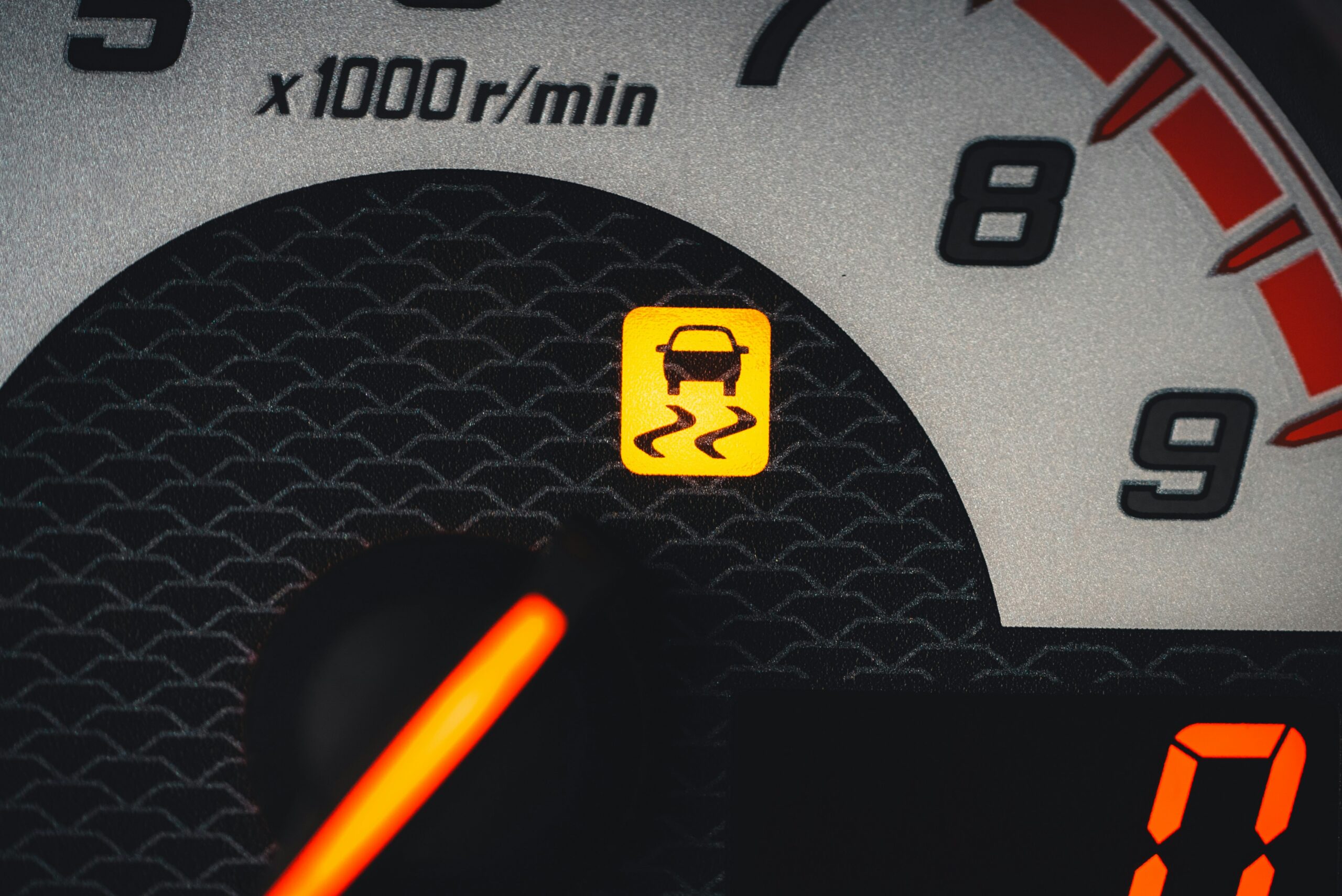
The traction control light helps alert drivers when the vehicle’s traction control system is active or needs attention.
Modern-day vehicles are equipped with numerous dashboard warning lights, but few are as confusing as the traction control light. Either it blinks ominously while driving on a wet road, only to disappear shortly after, or it refuses to turn off altogether after you’ve started the engine. Leaving your car is not an option, but are you safe to continue driving, or does the vehicle require immediate attention?
The traction control light is related to your vehicle’s Traction Control System (TCS). The vehicle’s Traction Control System works with the ABS brakes and the engine management system to ensure that power is distributed to the right wheels, restoring control when the car begins to skid or slip on the road surface. In many cases, the only sign that the system has engaged is the blinking of the traction control light on your dashboard.
If the traction control warning light is on, it can mean different things depending on the situation and the model of your vehicle. In this guide, we explain what the light means, how the system works, why it’s there, and what to do if the light blinks or remains on while driving.
A traction control system can be disabled by the driver, usually with a button or switch on the dashboard. If the light is on, it likely means that the system is turned off. But if you drove through a puddle with the TCS engaged, the light may have blinked as the system fought to regain control before vanishing. Traction control systems are more likely than not to involve the engine to reduce power or apply brakes on specific wheels to regain control, so it shouldn’t surprise you if the light blinked briefly as the system engaged.
However, the blinking light is the system telling you it’s doing something unusual, so it should only last a second or two. If the traction control light refuses to go away, there may be a problem. The most common causes are the driver disabling the system or a malfunction in the wheel speed sensors or another part of the system. It’s also possible that there’s an electrical issue causing the light to illuminate when it shouldn’t. The former is relatively easy to fix, but the latter two may require professional help to diagnose and repair.
What Is the Traction Control System?
What Is the Traction Control System? Understanding how anti-lock braking systems work helps explain how these safety features work together.
The Traction Control System This electronic safety aid is designed to reduce wheel spin when starting in gear on any surface that may result in limited traction, such as a wet surface, ice, gravel or mud, or on a hill where you require a faster getaway. The wheel speed sensors determine the condition where the outer wheel speeds can be a lot quicker than others and accordingly engine output may be reduced, individual braking of one of the wheels might be applied or in fact a dual function approach may be applied, depending on conditions.
Most modern vehicles integrate traction control with several other safety technologies, including:
- Anti-lock Braking System (ABS)
- Electronic Stability Control (ESC)
- Vehicle Stability Control (VSC)
- Engine Control Module (ECM)
Because these systems share components and sensors, a problem affecting one system may also trigger the traction control light.
What Does a Flashing Traction Control Light Mean?
A flashing traction control light is usually a sign that the system is working exactly as intended.
Such as speeding away from a green light when the street is wet following a rain shower. If one wheel begins to skid as the road has gotten slick, the Traction Control system will rapidly correct slipping or wheelspin, and the little dashboard light will flash for a few seconds before ceasing.
Common situations where the light may flash include:
- Driving on snow or ice
- Wet roads after rainfall
- Loose gravel or dirt roads
- Rapid acceleration
- Sharp cornering on slippery surfaces
A flashing light during these conditions is generally considered normal and does not necessarily indicate a problem.
What a Persistent Traction Control Light Means
Unlike a flashing light, a traction control light that stays illuminated usually indicates that the system has been disabled or has detected a fault.
In this situation, your vehicle will often continue driving normally under dry conditions. However, the added traction assistance may not be available when road conditions become slippery.
Several issues can cause the warning light to remain on.
The Traction Control System Was Switched Off
Many vehicles include a dashboard button that allows drivers to temporarily disable traction control.
This feature can be useful in specific situations, such as:
- Rocking a vehicle free from deep snow
- Driving through sand
- Navigating thick mud
If the button has been pressed accidentally, simply turning the system back on may cause the warning light to disappear.
Faulty Wheel Speed Sensor
Wheel speed sensors constantly monitor how fast each wheel rotates.
If one sensor begins sending inaccurate information, the traction control system may interpret the data as a fault and illuminate the warning light.
A damaged sensor is among the most common reasons the traction control light remains on.
Symptoms may include:
- ABS warning light
- Stability control warning
- Cruise control problems
- Inconsistent braking assistance
ABS System Problems
Since traction control relies heavily on the Anti-lock Braking System, faults within the ABS can also trigger the traction control warning.
Examples include:
- Damaged ABS wiring
- Failed ABS control module
- Faulty hydraulic components
- Sensor communication errors
Because these systems work together, it’s common to see both the ABS light and the traction control light illuminated simultaneously.
Steering Angle Sensor Issues
The steering angle sensor indicates the direction of turn of the steering wheel, so that other system computers know how the vehicle needs to adjust its behavior. When going round corners. Without this it may fail to calculate properly what is happening, and may fail. In some cases, recalibrating the sensor after a recent wheel alignment or changing of battery will fix the problem.
Low Tire Grip or Uneven Tire Wear
Low Tire Grip or Uneven Tire Wear can often be prevented by following proper tire pressure maintenance practices.
When it comes to the vehicle’s Traction Control System, proper tire management can make a difference. Unworn, properly-inflated tires of the same size will keep the car functioning at optimal levels without the TCS getting lost and confused. Worn tires and/or imbalanced tire pressure or wear can even cause the TCS to mistake the road for something other than what it is to create a safe and enjoyable ride, or cause it to fail, which of course will lessen your ride experience to some degree! Maintain your tires, and that will assure that when you go to get on those slippery or rutted roads that they will do so efficiently without slipping around!y.
Should You Worry About Driving with the Traction Control Warning Light On?
Whether it’s safe to continue driving depends on why the traction control light is on.
If the light flashes briefly on wet, icy, or loose roads, it’s usually a sign that the system is actively helping maintain traction. This is normal and doesn’t require repairs.
If the traction control light does not turn off, the system may have detected a fault and temporarily disabled its functions until the issue is resolved. In dry weather, your vehicle will often remain drivable, but you may lose an important safety feature that helps prevent wheel spin and improves stability on slippery roads.
If the traction control light appears together with the ABS warning light, brake warning light, or check engine light, it’s best to have the vehicle inspected as soon as possible, since multiple systems may be affected.
How to Diagnose a Traction Control Light
How to Diagnose a Traction Control Light is simpler with our automotive guides.
Use a troubleshooting routine When searching for what caused you will generally need to troubleshoot systematically, step by step. Begin by looking to check whether somebody has actually deactivated the stability control system and have forgotten regarding have that it back on just by pushing the button situated upon the automobile dash panel.
While if you have the traction control on and also the traction warning light is definitely, look into the automobile’s tires to make sure they fit, worn consistently, and also the appropriate pressure hasactually already been filled toward their. The succeeding factor might be to fit a car OBD-II checking scanner on account of that stability control problems the save diagnostic issue rules which recommend towards issues such as:
- Faulty wheel speed sensors
- ABS module issues
- Steering angle sensor faults
- Wiring or electrical problems
- Engine management system errors
Because several systems work together, a professional diagnostic scan is often the quickest way to identify the exact cause.
Common Repairs and Potential Costs
The repair depends on the underlying problem rather than the warning light itself.
Some common repairs include:
- Replacing a damaged wheel speed sensor
- Repairing broken wiring
- Recalibrating the steering angle sensor
- Replacing an ABS control module
- Correcting tire pressure or replacing worn tires
Repair costs can vary significantly depending on the vehicle make, model, labor rates, and the failed component. A simple sensor replacement is generally much less expensive than replacing an ABS module or diagnosing complex electrical faults.
Common Mistakes Drivers Make
Many drivers misunderstand what the traction control light is trying to communicate.
Avoid these common mistakes:
- Ignoring a warning light that stays on for days or weeks.
- Assuming the light always means the vehicle is unsafe to drive.
- Replacing parts without performing a proper diagnostic scan.
- Turning the system off unnecessarily and forgetting to reactivate it.
- Neglecting routine tire maintenance and wheel alignments.
Understanding the difference between a flashing light and a constant warning can prevent unnecessary repairs and improve safety.
How to Help Prevent Traction Control Problems
Although not every failure is avoidable, regular maintenance reduces the likelihood of traction control issues.
Good preventive habits include:
- Maintain proper tire pressure.
- Replace tires before the tread becomes excessively worn.
- Having your tires rotated at the recommended intervals can help your vehicle maintain proper traction, stability, and tire durability.
- Keep wheel speed sensors clean when possible.
- Repair ABS warning lights promptly.
- Have wheel alignments performed when needed.
- Address electrical issues before they affect multiple systems.
Routine inspections can often identify small problems before they trigger dashboard warnings.
Conclusion
The traction control light is an important safety indicator that helps drivers understand whether the vehicle’s traction control system is operating normally or has detected a problem. A flashing light usually means the system is actively preventing wheel slip on low-traction surfaces, while a light that stays on often signals a fault or that the system has been switched off.
Although most cars are safe to drive with the traction control system turned off on dry pavement, the loss of traction assistance can make them challenging to handle on wet or slippery roads. Recognizing the causes of the traction control light, ranging from wheel speed sensors to ABS problems, steering angle sensors, or even tire issues, can help you get your vehicle back to its total safety.
Frequently Asked Questions
1. Why is my traction control light on, but my car is driving fine?
The traction control warning light indicates that either the car’s traction control system is off, or there is a malfunction. In most cases, your car will continue to drive normally, but it will lack the power from the traction control system.
2. Is it safe to drive with the traction control light on?
In most cases, it is safe to drive with the traction control light on, especially if you are on dry pavement. However, it is necessary to have the car diagnosed and repaired to ensure that the system works appropriately on wet or slippery roads.
3. Can low tire pressure cause the traction control light to illuminate?
Low tire pressure, uneven tire wear, and bad tires are some of the most common causes of the traction control system error. In addition, the car’s onboard computer can interpret incorrect tire speed and wheel spin information, causing the traction control light to illuminate.
4. Will the traction control light reset itself?
If the traction control warning light comes on due to intermittent wheel spin, it will turn itself off. However, if the light is on, there is a high chance that the car will require service.
5. Can a bad wheel speed sensor cause the traction control light to come on?
A bad or faulty wheel speed sensor can cause the traction control light to come on because it is one of the most crucial sensors in the car’s traction control system. In addition, the wheel speed sensor can cause other problems, such as ABS failure.
6. Can check engine light and traction control light come on at the same time?
Yes, the check engine light and the traction control light can come on simultaneously. Some malfunctions, such as computer issues, can cause multiple warning lights to illuminate since the car’s computer runs most systems.