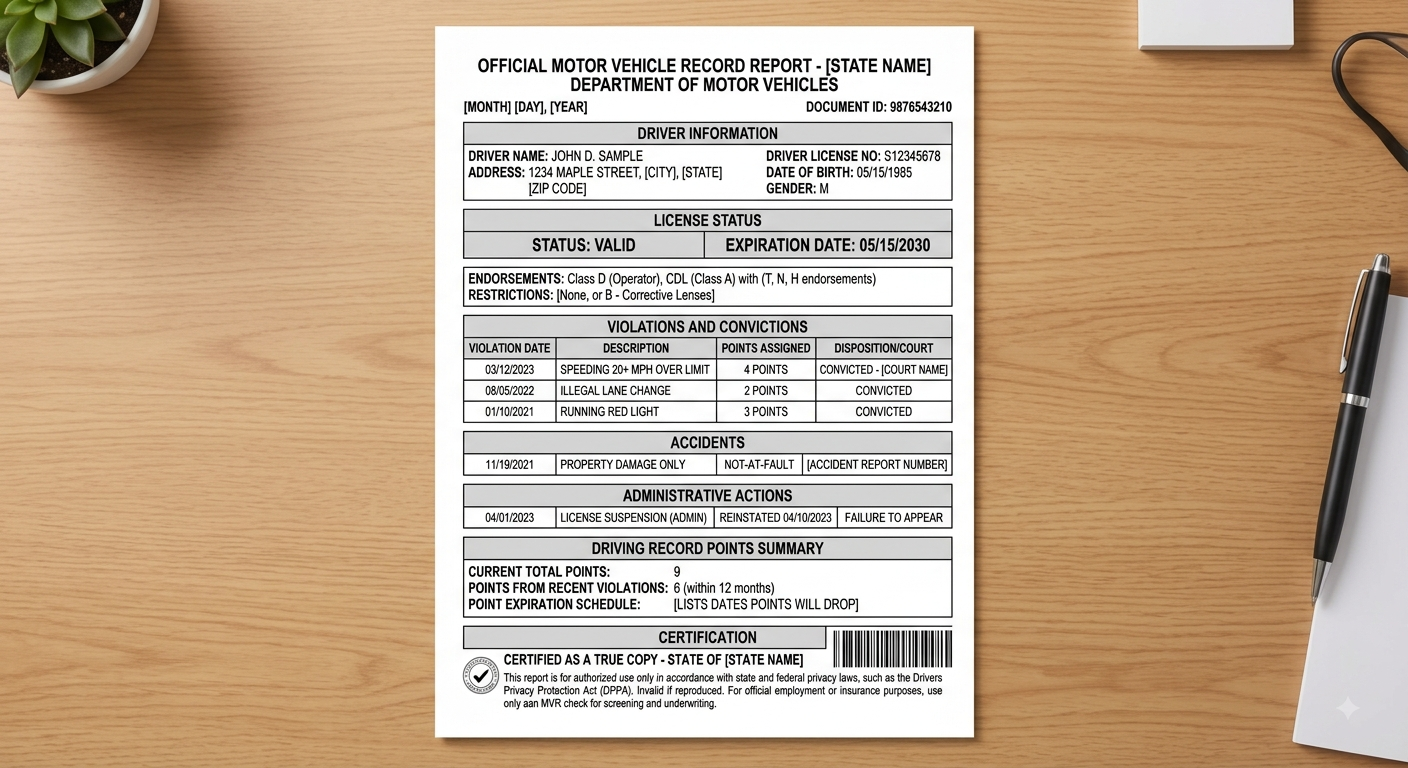
When a potential employer requests an MVR, the process can actually be much simpler than you may be made to think. An MVR in itself stands for Motor Vehicle Record. This type of check is an official history of your driving experience, on file with your state’s department of motor vehicles. It can include information such as license status, traffic tickets, convictions, suspensions and restrictions, endorsements, and other traffic-related happenings, depending on the specific state and record type.
Why is it so important to have an MVR? The concept is actually very basic. Your driving history can be a representation of whether or not you are legally allowed, and are somewhat competent, to operate a vehicle. This is especially important for jobs requiring company cars, delivery drivers, commercial truckers or other kinds of transport professionals, or any driving-related profession. Insurance companies may also make use of Motor Vehicle Reports while assessing driving behavior.
As a side note, although MVRs are not exactly the same in every state-each state may track the same information under different terms, and available histories may not be as extensive or even contain the same kind of data-it’s good to know what it is that makes these checks important.
Why Do People Search for an MVR Check?
The question “what is an MVR check?” usually appears at a practical moment. Someone may have applied for a job and been told that their driving record will be reviewed. Another person may be comparing insurance requirements or trying to understand what appears on their official driving history.
In part, this is due to mistaking an MVR for a broad background check. An MVR is quite specialized. It’s designed specifically around driving and criminal behavior closely tied to that behavior.
It’s less a general criminal or employment check and more tied specifically to a person’s driving record.
That distinction is particularly important for businesses that use employees to drive, because what is most important are the driving habits of employees more than their overall financial picture or other information.
What Information Appears on an MVR?
There is no single nationwide MVR format. Still, state driving records commonly contain several categories of information.
Driver and license information
You can find the driver involved and license information such as the driver’s license number, class, driver’s name, current status, license restrictions, and endorsements depending on where the driver obtained the license and type of driver record being purchased. Some common license status types you will see on driver records include valid, suspended, canceled, expired, revoked, and other administrative driver’s license status types. The Colorado Division of motor vehicles offers status, a credential record, a commercial status of the driver, a history of convictions, tickets as well as reinstatement instructions on what you might have to do in order to make up for license withdrawals, such as cancellations and suspensions.
Traffic violations and convictions
Vehicle operations can also factor heavily into this area. This section is particularly focused on citations, convictions, points, and certain serious violations-though the presence of this content is subject to state laws and record-type. Certain records will also contain vehicle-related criminal offenses or driving under the influence (DUI).
Accidents and other driving events
The possibility also of an \”accident\” could also possibly come up, but again, not necessarily would every single \”accident\” possibly come up on every type of MVR report. There can be reporting requirements of individual states that can effect what a reporting agency is able to access about an accident and this just relates back to individual means of reporting incidents. So, think about the MVR just as official recorded history regarding license activity rather than a national library for every \”accident\”.
What Does an MVR Check Look For?
An MVR check is usually designed to resolve a question with a pretty tight focus: What does this person’s driving history and current aptitude say in the existing record? For a potential employer, it may involve reviewing whether this person possesses the correct driving license, how recent that license is, and whether there’s any issue on the record that’s inappropriate for your safety expectations for a drivers. For a potential insurance company, it’s a useful method for obtaining some additional context to a driving risk evaluation.
MVR’s have routinely helped insurers evaluating whether to assign coverage in reviewing licence status and history.
It is worth noting what a specific finding suggests. It seems quite unlikely the same weight should be assigned to a parking ticket and a revocation. Each insurer and company might choose to review based upon its own criteria.
Who Uses MVR Checks?
MVR check is in particular more commonly done to any number of agencies as they have some specific reason that you wish to check with an individual on any their past drivin-ng related records and any of driving record violations or any of your accidents.
Employers
A company might look up an MVR for a number of scenarios involving the role an employee plays and the need for that employee to drive a vehicle for business needs. Such positions include: Commercial vehicle drivers; Delivery people; Sales employees that drive company cars or other vehicles; Transportation workers, and Other employees for whom driving is an inherent part of their job functions. “The real concern is practical,” said Thomas B.
In any case, “If we put someone out there in the driver’s seat, they have to be licensed appropriate and the background needs to be acceptable in terms of company policy.
” Federal law may make additional demands on commercial drivers “ Federal laws may require[ a employer]to go to and seek prior consent for the driver in order to receive information from any of Federal Motor Carrier Safety Administration clearing house and drug/alcohol clearances”, explain the Thomas B. ‘s website page where MVRs is described, “This clearing house of commercial drug testing information not only is not your state record and is also the primary record that any employer must search and review when dealing with people commercial.
Insurance companies
Insurers also use motor vehicle reports to access information about driving history. They can show information about traffic tickets, license status, violations and any convictions or other relevant actions that might be a factor in underwriting or pricing a policy. The specific way an insurerusesthis information can vary greatly from insurer to insurer, policy to policy, and state to state.
Individuals
Any licensed driver is permitted to get their driving record by themselves. There are many reasons that this can be advantageous, for example, it can help you to ensure that the information the licensing bureau is aware of is correct, or it could be the practice of taking part in a position or work opportunity that would require someone to do it.
By way of example, in Arizona, eligible driver license holders are given authorization for requesting and printing away their vehicle information document, in addition to other ways you can obtain a driver license report using the State of Arizona. In Colorado, a driver can buy their official Colorado driving history and any type of certified Colorado state motor vehicle report by either online, mail order or in a local center.
How Is an MVR Check Different From a Background Check?
There’s perhaps no other background check distinction that is more valuable than these two. What an MVR check involves vs what a full employment screening entails There’s all types of criteria involved in what goes into an employment background check, whereas the MVR check is really confined to a person’s driving records. Essentially it’s like using two differently equipped set of tools to view information on a person: employment history or criminal records for an employment background check, whereas your MVR will strictly deal with how they’ve performed behind the wheel. It simply shouldn’t be taken at face value as a full, comprehensive investigation.
Does an MVR Show Every Ticket or Accident?
Not necessarily.
One big misunderstanding of an MVR is that it is a “final” comprehensive history of everything that ever occurred while an MVR holder was operating a vehicle. However, what can be seen depends on the state, what type of MVR it is, reporting laws of the state/type of information, and rules governing retention of information. For instance, theColorado government site identifies different categories of driving records and specific information that goes on these records: \[image removed\] As seen, accident information is identified as a category of data on records from this state.
However, just because an accident occurs and exists on one record does not mean it will also show up on another; information that is recorded in other databases does not automatically translate over to state-driving records.
Thus, the person reading the MVR will want to carefully note which state the MVR came from and how it is described on the MVR in lieu of assuming it contains every single driving event on the holder’s record.
Can an MVR Affect Employment?
It can, particularly when driving is part of the job.
An employer may have rules about what kind of driving history they require. Every employer, and even every different job at one company can require a different sort of driving history. For instance, an employer looking to hire a part-time driver of a passenger car could look at a driving history differently from a transit company that needs to hire a commercial driver. A driving history that meets the requirements for a position at one company may not meet the requirements for a position at another company.
If the driving history shows a suspension, a severe traffic conviction or another more serious offense, this could be relevant in determining an applicant’s qualification for a driving position. However, having a single minor violation should not, by itself, disqualify the applicant. The employer is the one who determines if the information on the driving record is a positive or negative indicator that the applicant is suited for the job (within any constraints imposed by applicable law).
Do You Need Permission for an MVR Check?
The answer depends on who is requesting the record, what system is being accessed, and applicable law.
MVR Privacy limitations state motor vehicle record data has strict privacy rules. Arizona notes that various federal and state privacy laws govern the protection and disclosure of specified information contained in motor vehicle records and dictate specific permissible uses for protected information contained therein. Commercial driving records also contain specific federal law guidelines.
Under federal law, the employer should be precluded from accessing driver information from the FMCSA Clearinghouse without the consent listed therein.
Thus, inquiring MVR does not automatically allow an individual to obtain the entire driving record for any other individual without restrictions.
How Can You Get Your Own MVR?
Start with the state motor vehicle agency that holds the record The most reliable first place to start ordering a driving record is the official department of motor vehicles or MVD in the state where you live-or have lived if applying for older records. Most states allow you to order records online-many even allow ordering by mail or in-person as well, although specifications about acceptable document types, identifying requirements, costs, and processing times vary by state. Arizona offers information online on ordering non-official driving records or obtaining your Arizona Motor Vehicle Division driving record through a driving record search, for instance.
Colorado offers onlineorderingfor records in either certified or non-certified formats.
Double-check before ordering your driving record If your employer is requesting a driving record, be sure to check if there’s a particular type they want: the request specifies an official, certified driving record, or driving records for a specific period. Simply ordering any record type might not suffice if a certified document is specified.
What Should You Do If Your MVR Contains an Error?
Errors on Your Driving Record Can Cause Trouble When driving record affects employment or insurance, those errors are an unwelcome complication for all concerned. Here’s how to deal with an errant line on your report: Pinpoint What’s wrong Forcing yourself to look closely enough to see exactly why it seems mistaken, comparing your driving report to your court documents and official driver’s records from licensing agencies, is essential. Once that’s done, you may have a clear idea what state agency to contact for corrections, using the agency’s designated procedure.
Just Remember Don’t assume a third-party screening report writer will be able to correct the original, state-run motor vehicle record.
Often, the agency providing that record is your destination, not the screening agency screening it for an employer. Document Everything As long as you keep careful documents, proof will ease your proof. You can demonstrate the precise reasons why a particular data entry is incorrect.
Common Mistakes People Make About MVR Checks
It means the wrong assumption: “MVR is the same as criminal record check” not everyone sees the difference. MVR relates most to driving record and license information, not a full legal or criminal history. Number Two common driver error “all crashes and accidents show up on MVR”.
“Whether crash and accident report can get on record totally depends on your State DOT rules”, says Mr.
Scott (of National Background Check).
Number Three common driver error “don’t know that it show up till I get out here trying to work. My advice is always get their own Driving Records from their state of operation before or around when that employee will submit application” and Number Fourth common driver error “don’t get what shows on other driver”. For example, “Drivers can and do often conflate regular state MVR records with the federal CDLIS and other relevant commercial-driver databases.”
How Long Does an MVR Stay Clean?
There is no single nationwide answer.
State-specific laws also dominate on the driving record front, and violations remain on them for differing amounts of time. The type of record requested can also play a part. Instead of relying on a general statement like “tickets fall off after a set number of years,” check with the state responsible for holding the record to clarify what type of driving record is involved. This is especially important for jobs where they require X number of years driving history.
Why Checking Your Own Driving Record Can Be Worthwhile
An MVR isn’t just the type of data your employer or insurers seek – it’s often a helpful record for the driver too. Looking at your record yourself gives you an idea of the status of your driving record, the types of violations outstanding or reported, and any restrictions or endorsements added to the record, or errors which need amending; it offers some peace of mind before someone else reviews your record. For commercial drivers, issues become more significant due to potential role changes in licensing vs federal compliance programs. The approach to MVR’s remains unchanged: get the right official version, check everything and get anything you don’t understand clarified by the issuing office.
Conclusion: What Is an MVR Check?
So, what is an MVR check? In simple terms, it is a review of a person’s Motor Vehicle Record, or driving history, usually maintained by a state motor vehicle or driver-licensing agency. It can provide information about license status, restrictions, endorsements, traffic violations, convictions, suspensions, and other driving-related activity, although the exact contents vary by jurisdiction and record type.
For you as a driver, knowing an MVR is relevant for you because the record can impact employment for a driving position, insurance companies, and the holder of a commercial license, or ensure accuracy of personal records. Don’t wonder what your MVR says-actually check your MVR and understand the rules it falls under.
In essence, an MVR check merely provides a photographic snapshot of a driver’s recorded past-it is not a comprehensive evaluation of the person driving. By knowing what the record says, you’ll have a more accurate picture of where you stand and know exactly what needs to be done to ensure you’re in the best shape possible.
Frequently Asked Questions
1. What does MVR stand for?
MVR commonly stands for Motor Vehicle Record. It refers to a record of a person’s driving and licensing history maintained by a state motor vehicle or driver-licensing agency.
2. What does an MVR check show?
An MVR may show license status, license class, restrictions, endorsements, traffic violations, convictions, suspensions, revocations, and other driving-related information. The exact contents vary by state and record type.
3. Is an MVR the same as a background check?
No. An MVR is specifically focused on driving and licensing information. A broader background check may examine other categories of information depending on its purpose and applicable law.
4. Can an employer check your MVR?
Employers may be able to obtain driving records when they have a legally permitted reason and follow applicable requirements. Commercial-driver records can have additional federal consent rules.
5. Can you check your own MVR?
Yes. Drivers can generally request their own driving record through the appropriate state motor vehicle agency, although eligibility, fees, identification requirements, and available record types vary by state.
6. Does an MVR show accidents?
MVRs often include accidents, but it is not guaranteed that every accident, no matter how small, shows up on a driver’s driving history report. Procedures regarding what events a state must report and include in a driver’s driving record varies from state to state.
7. What should you do if your MVR is wrong?
Review the notice carefully and obtain supporting evidence such as pay stubs, police reports, and insurance forms. Your next step should be to contact the state agency where you obtain and use your license and has access to the driving record. Report the mistake to them. They have their own way in which to correct information on your driving record and they know how you are supposed to do that.